
The wrong casino management system rarely fails in the sales demonstration. It fails later—during a network interruption, a disputed meter, a player-account merge, a multi-property rollout or the first request for data the operator cannot export cleanly.
Choosing a casino management system is therefore not a feature-list exercise. The decision determines how the property records gaming activity, controls cash, tracks players, delivers loyalty benefits, recovers from outages and converts operating data into management action.
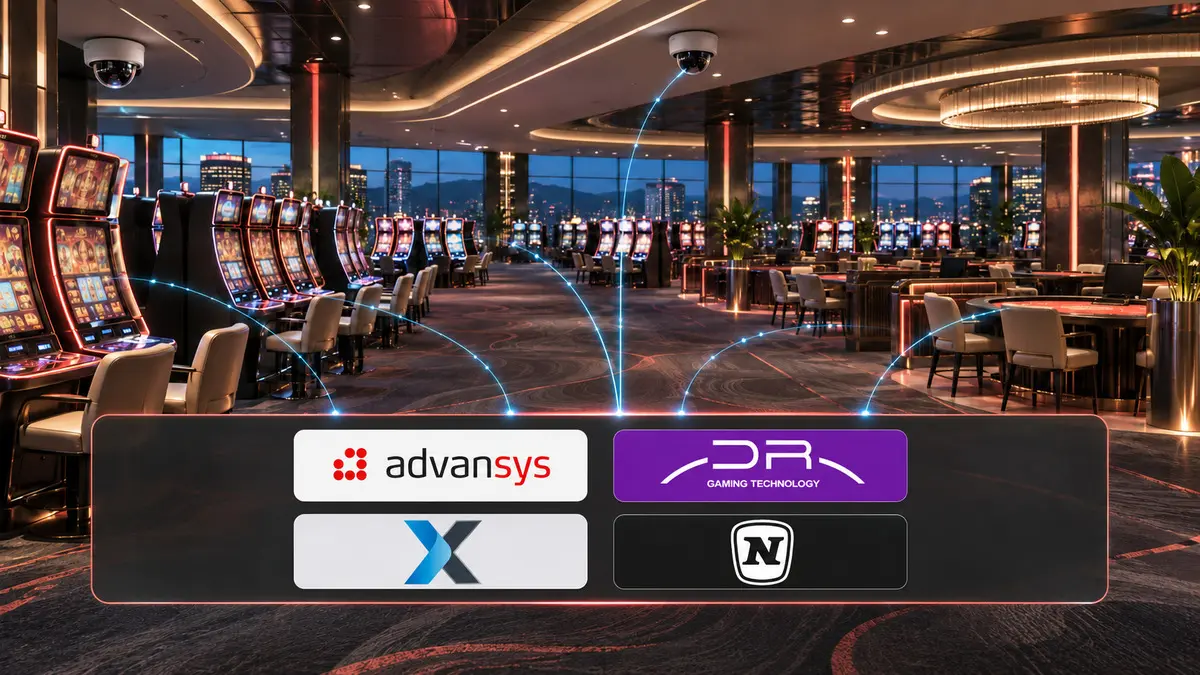
Modern platforms now combine slot accounting, player tracking, cage, tables, loyalty, cashless, jackpots, mobile tools and analytics in different ways. DRGT, Advansys NEXIO, NOVOVISION, IGT ADVANTAGE X, Konami SYNKROS, Aristocrat OASIS, Light & Wonder Systems and other suppliers all bring credible capabilities. The correct shortlist depends on the operator’s jurisdiction, scale, existing equipment, internal resources and tolerance for vendor dependence.
The examples, weights and time targets in this article are illustrative. Any proposed CMS must be evaluated against the operator’s licensing conditions, technical standards, AML/KYC duties, player-protection rules, privacy obligations and approved accounting policies.
Start With the Operating Model, Not the Vendor Demo
A CMS should fit the way the casino intends to operate. Before inviting suppliers, document the properties, departments, currencies, player journeys and control points the platform must support.
- Number of properties, gaming machines, tables and cash desks
- Single-property or centralized multi-property player accounts
- Carded, cardless, anonymous, cashless and TITO play
- Slot meters, accounting, jackpots and hand-pay workflows
- Table ratings, fills, credits, markers and chip inventory
- Cage, vault, currency exchange and financial reconciliation
- Loyalty, comp, free-play, promotion and host authorization rules
- AML/KYC, exclusion, limit and responsible-gaming controls
- Hotel, point-of-sale, CRM, finance, identity and payment integrations
- Languages, currencies, tax rules and local reporting requirements
Replace vague requirements such as “must support multi-property” with testable scenarios. For example:
“A guest is registered at Property A, plays at Property B, redeems an offer at Property C and later requests an account correction. Demonstrate how identity, balances, permissions, audit history and financial postings remain consistent across all three sites.”
This approach reflects the wider casino management control framework: systems must support daily execution, not merely produce reports after the event.
The Current Casino Management System Landscape
The following snapshot is not a ranking. Product scope, certification and available modules vary by market and contract. It is a starting point for deciding which suppliers deserve a detailed request for proposal.
| Provider and Platform | Current Positioning | What to Verify in the Demo |
|---|---|---|
| DRGT | Integrated CMS, cashless and jackpot solutions built around the drSMIB mesh architecture | Offline behavior, floor-device recovery, multi-site controls, jackpot accounting and local support coverage |
| Advansys NEXIO | Modular platform covering accounting, cage, TITO, cashless, loyalty, multi-currency, multi-site operations and reporting | Module depth, API coverage, configuration ownership, report flexibility and implementation resources |
| NOVOMATIC NOVOVISION | Scalable CMS spanning slots, live tables, cash management, loyalty, jackpots and selected online or betting connections | Biometric and cashless workflows, machine compatibility, regulatory configuration and cross-property design |
| IGT ADVANTAGE X | Modernized on-premise and cloud-capable architecture with real-time data, analytics and player-engagement functions | Migration path from legacy ADVANTAGE, cloud responsibilities, event access, licensing and integration cost |
| Konami SYNKROS | Enterprise CMS covering slots, tables, cage, credit, vault, marketing and business intelligence | Property-wide data model, promotion controls, table workflows, reporting access and regional service capacity |
| Aristocrat OASIS | Core casino management supported by OASIS loyalty, connect, wallet, mobile and operational applications | Version roadmap, integration between modules, mobile enrollment, wallet controls and data export |
| Light & Wonder Systems | Core systems, analytics, marketing, managed services and player-service capabilities | Exact module scope, modernization path, interface ownership and long-term support for installed components |
| Comtrade Gaming sCore | Land-based systems management, central control and G2S/S2S connectivity | Protocol compatibility, direct EGM communication, monitoring depth and fit with the operator’s primary CMS |
A large installed base does not automatically make a system suitable for a particular property. A smaller regional provider may offer better localization and faster support. A global supplier may provide deeper certification coverage, broader integrations and a longer product roadmap. Both claims must be tested against the proposed version, market and implementation team.
Choose the Architecture Before Comparing Features
The platform’s architecture affects availability, cybersecurity, upgrade effort and long-term cost. Current proposals may be on-premise, cloud-hosted or hybrid. Some systems retain more intelligence at the floor device; others depend heavily on central services.
| Architecture Question | Why It Matters | Evidence to Request |
|---|---|---|
| What continues during a server or WAN outage? | Determines whether play, ratings, cashless balances and cage operations can continue safely | Live failure demonstration and reconciliation report after restoration |
| Where is transaction state stored? | Affects recovery, duplication risk and data-loss exposure | Architecture diagram, event flow and recovery sequence |
| Who operates the infrastructure? | Defines responsibility for patching, backups, monitoring and capacity | Responsibility matrix and service description |
| How are upgrades deployed? | Controls downtime, regression risk and certification effort | Release process, rollback plan and recent customer example |
| Can properties be separated during disruption? | Limits the effect of a central or cross-property failure | Failover test across realistic network conditions |
Do not accept “high availability” as a complete answer. Ask which individual services are redundant, how failover is triggered, what staff can still do and how every deferred transaction is validated after recovery.
Test Data Ownership and Portability Early
Standard reports are not proof that the operator controls its data. The contract and technical design must define ownership of raw transactions, derived values, player records, configuration history and audit logs.
For every critical data domain, identify the authoritative source:
| Data Domain | Possible System of Record | Required CMS Control |
|---|---|---|
| Player identity | CMS, KYC platform or enterprise CRM | Unique identity, duplicate handling and traceable updates |
| Slot meters and events | Gaming system | Collection, validation, reset handling and immutable history |
| Cage transactions | Cage module | Authorization, balancing and financial reconciliation |
| Hotel and non-gaming spend | PMS and point-of-sale systems | Reliable matching to the player and economic cost |
| Financial accounting | ERP or general ledger | Controlled journals, cut-off and reconciliation status |
Require a sample full export before contract signature. It should include transaction detail, reference tables, effective-dated configuration, audit history and a usable data dictionary. The exit clause should state format, timing, validation support and cost.
Management error: Discovering during migration that “data access” meant access to screens and predefined reports rather than a complete, documented export.
Prove the Integrations End to End
An API catalogue is useful, but it does not prove that the business process works. For each critical interface, establish:
- Direction, timing and authoritative source of each field
- Authentication, authorization and encryption
- Versioning and backward compatibility
- Idempotency and duplicate-transaction protection
- Error queues, retry logic and manual correction rights
- Monitoring, alerts and correlation identifiers
- Sandbox availability and realistic test data
- Vendor responsibility when the interface fails
Prototype the highest-risk journeys before signing. Typical priorities include identity, exclusion status, slot meters, jackpots, hotel charges, player benefits, payment wallets, finance journals and tax reporting.
The test should begin with the source event and finish with reconciliation in the receiving system. A successful API response is not enough if a later adjustment cannot be reversed, traced or reposted correctly.
Evaluate Cashless, Cardless and Mobile as Control Systems
Cashless and mobile functions now appear in many CMS proposals, but the operator should examine the complete money and identity flow rather than the convenience of the player interface.
- How is the player identified, authenticated and reverified?
- Where is the wallet balance legally and technically held?
- Which deposit, transfer, play and withdrawal limits apply?
- What happens when the phone, card, machine or network is unavailable?
- How are disputes, reversals and abandoned sessions handled?
- Can exclusions and responsible-gaming limits be enforced across channels?
- Who reconciles the CMS, payment provider, cage and bank settlement?
A smooth player journey can still produce a weak control environment if identity, wallet and gaming records are split between suppliers without a clear owner for exceptions.
Verify Cybersecurity and Auditability
The CMS sits close to money, personal data and regulated gaming activity. Security review should cover the full environment: servers, floor devices, interfaces, remote support, administrator accounts, backups and third-party components.
For every critical change, the system should record who acted, when it happened, the old and new values, the affected record, the approval path and the originating device or channel. Audit records need controlled access, retention, export and protection against unauthorized modification.
Request evidence for:
- Role-based access and privileged-account management
- Multi-factor authentication for administration and remote support
- Patch, vulnerability and end-of-life management
- Network segmentation and service-to-service authentication
- Backup immutability and restoration testing
- Security-incident notification and forensic support
- Penetration testing and remediation governance
- Supplier and subcontractor access controls
Cybersecurity obligations should be contractual. A supplier’s general security statement does not define response time, evidence access or financial responsibility after an incident.
Require Live Recovery Demonstrations
Business-continuity testing should include central service loss, property-to-property WAN interruption, floor communication failure, cage unavailability, identity-service failure and disaster-recovery failover.
RTO = Maximum acceptable time to restore the service
RPO = Maximum acceptable data-loss window
The demonstration should show the degraded operating state, not only the final recovery. Document which transactions remain available, which limits still apply, which controls become manual and how the restored records are reconciled without duplication.
Measure Reporting by the Decisions It Supports
A CMS may contain hundreds of reports and still leave managers rebuilding the numbers in Excel. Every important output should have a defined decision, source fields, refresh timing, reconciliation status, exception owner and drill-down path.
For slot operations, verify that machine identity, location, configuration, availability, meter history and game changes remain effective-dated. Without that structure, even sophisticated slot analytics and floor optimization can attribute results to the wrong machine, game or location.
Artificial intelligence and automated recommendations should be evaluated with the same discipline. Ask which data was used, how the recommendation can be reproduced, whether the model is vendor-controlled and how management can override or audit the output. “AI-powered” is not an acceptance criterion.
Calculate the Full Five-Year Cost
Five-year TCO = Licence + infrastructure + interfaces + migration + certification + support + training + internal resources + upgrades + exit cost
Request a cost model that separates mandatory components from optional modules and volume-based charges. Include non-production environments, API access, data storage, travel, out-of-hours support, regulatory changes, new properties, replacement floor devices and supplier-transition assistance.
The technology workstream inside a casino development project should compare the cost of implementation with the cost of operating and changing the platform after opening. A lower initial licence can become expensive when each interface, report or property requires a separate commercial agreement.
Use Mandatory Gates Before Weighted Scoring
Some failures should eliminate a proposal regardless of price or feature score. Mandatory gates may include regulatory suitability, transaction integrity, auditability, recovery, security, data export and support in the operating region.
Only suppliers that pass the gates should enter weighted scoring.
| Evaluation Dimension | Illustrative Weight | Minimum Evidence |
|---|---|---|
| Operational fit | 25% | Scenario-based live demonstration |
| Data and integration | 20% | Prototype, documentation and sample export |
| Compliance, controls and audit | 20% | Traceable end-to-end transaction tests |
| Resilience and cybersecurity | 15% | Failure, restoration and security evidence |
| Implementation and support | 10% | Named team, plan and comparable references |
| Five-year commercial value | 10% | Transparent TCO and exit terms |
Score only what is available in the proposed production version or contractually committed for delivery. A roadmap item should not receive the same score as a proven function.
Run a Pilot and Formal Acceptance Test
- Define critical operating scenarios and acceptance thresholds.
- Validate a sample migration, including duplicate and incomplete records.
- Test realistic transaction volumes and peak conditions.
- Reconcile slots, tables, cage, loyalty and finance outputs.
- Interrupt services and verify recovery, resynchronization and audit history.
- Test roles, approval limits and segregation of duties.
- Record defects, owners, workarounds and conditions that block go-live.
Payment milestones should depend on verified deliverables. When the contract affects regulatory controls, financial reporting and long-term supplier dependence, an independent casino consultancy review can test the proposal without a commercial interest in the selected platform.
Check the Vendor Behind the Platform
The proposed software version is only part of the decision. Review the supplier’s financial position, ownership, regional support, certification experience, implementation team, product roadmap, end-of-life policy and customer references at comparable properties.
Reference calls should address difficult operating questions:
- Which reconciliation problems appeared after go-live?
- How quickly were critical incidents escalated and resolved?
- Which costs were not clear in the original proposal?
- How disruptive were upgrades?
- Can the property obtain and use its own detailed data?
- Which functions still require spreadsheets or manual work?
The Final Decision Should Be Evidence-Based
Choosing a casino management system should end with a documented evidence trail: requirements, mandatory gates, scenario results, integration prototypes, recovery tests, reference findings, five-year cost and negotiated contractual protections.
The best platform is not the one with the most polished demonstration. It is the system that fits the operating model, records transactions correctly, remains controllable during disruption, supplies trustworthy data and can be changed or replaced without trapping the operator.
The final step before contract signature is to repeat the highest-risk scenarios using the proposed production version, named implementation team and agreed architecture. Any material assumption that remains untested should stay visible in the decision log with an owner, deadline and commercial remedy.
Source note: Product descriptions were checked against the suppliers’ current official materials for DRGT, Advansys NEXIO, NOVOVISION, IGT ADVANTAGE X, Konami SYNKROS, Aristocrat OASIS, Light & Wonder Systems and Comtrade Gaming sCore. Operators should verify current certification, modules and commercial availability directly with each supplier.